
Context & Visual Identity – Distressed Red Painted Wood
This distressed red painted wood material reflects surfaces that have been exposed to years of use. The deep, worn red layer reveals lighter undercoats and raw wood beneath. As a result, the surface feels authentic rather than artificially aged.

You typically see this type of painted wood in industrial lofts, renovated warehouses, old workshop furniture, and repurposed architectural elements. The visible scratches and linear wear patterns communicate history. At the same time, the subtle reflectivity suggests that the paint once had a protective finish.
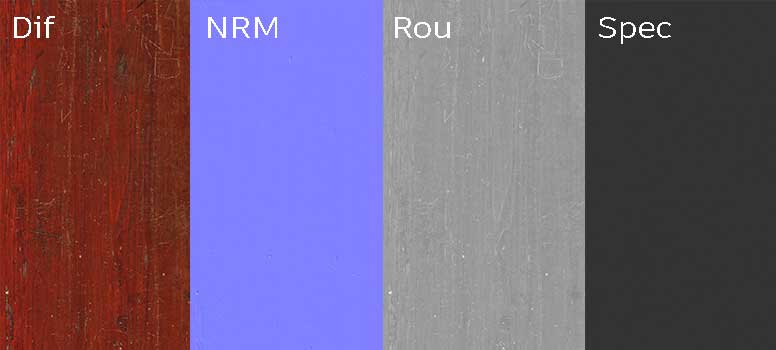
Because the wood grain remains slightly visible under the paint, the material keeps its structural identity. Therefore, it works well in projects where narrative and imperfection are part of the design language.
Typical Problems This Painted Wood Texture Solves
In many renders, aged painted wood looks procedural. Scratches repeat too evenly. Color variation feels artificial. This painted wood texture avoids that issue through organic, irregular damage distribution.
Another common challenge is balancing roughness. If everything is too matte, the surface looks flat. If it is too glossy, it loses realism. Here, roughness varies naturally. Worn areas are slightly more reflective, while intact paint remains more diffuse.
Tiling is also critical in large panels or doors. Since this material is seamless, it can be applied across extended surfaces without visible repetition lines.
Practical Use Cases – Vintage Painted Wood in Real Projects
This distressed red painted wood PBR works well in:
-
Industrial loft interiors
-
Vintage doors and wall panels
-
Decorative wooden tables or countertops
-
Exhibition stands with reclaimed aesthetics
-
Game environments with abandoned or workshop themes
-
Archviz scenes that require aged character surfaces
In architectural visualization, it can be used to create focal elements inside neutral interiors. For example, a red worn panel behind a bar counter immediately adds contrast. In game development, it supports storytelling in post-industrial or urban decay environments.
Because the scratches are detailed and layered, the material holds up in close-up shots. Therefore, it is suitable for hero assets as well as background elements.
Rendering & Realism Notes – 8K Distressed Wood PBR
This free painted wood material is delivered in 8096×4096 resolution. The 8K detail captures fine scratches, chipped paint edges, and subtle surface irregularities.
The roughness map is calibrated to create controlled reflectivity. Under directional lighting, slightly polished worn areas catch highlights at grazing angles. Meanwhile, intact painted zones remain more matte. This variation increases depth without relying on heavy displacement.
In studio lighting, the surface reads clearly. In HDRI daylight setups, it reacts naturally. As a result, the material performs consistently across still renders and animations.
Render Engine Compatibility – Unreal, V-Ray, Corona
This distressed red painted wood material is ready for Unreal Engine, V-Ray, and Corona Renderer. In Unreal, it connects directly to standard PBR inputs for real-time scenes. In V-Ray and Corona for 3ds Max, reflection and roughness values translate accurately with minimal adjustment. Additionally, the texture maps can be used in any PBR-based workflow.
Workflow Advantage with AfterBox
The free material is accessible inside the lightweight AfterBox application (approximately 16MB).
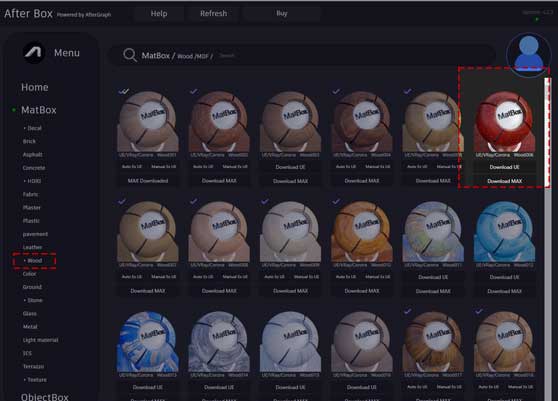
Within the software, users can drag and drop the prepared material directly into Unreal Engine or into V-Ray and Corona inside 3ds Max.
This approach reduces manual shader setup. Instead of building materials from scratch, you can apply the distressed painted wood surface instantly and adjust it within your scene context.
Access details and subscription plans are available here:
https://after-box.com/pricing/
Built-in Dirt & Reflection Variation Control
Inside AfterBox, this free painted wood PBR includes advanced dirt controls. With a single click, you can introduce additional dirt variations to the base color layer.
More importantly, dirt can be applied independently to the reflection channel. When dirt affects only reflection, it becomes visible primarily at specific viewing angles. This subtle effect enhances realism, especially in cinematic close-ups. As a result, the material avoids a flat procedural look and feels physically grounded.
Access a comprehensive library of painted wood materials with an AfterBox subscription.
