


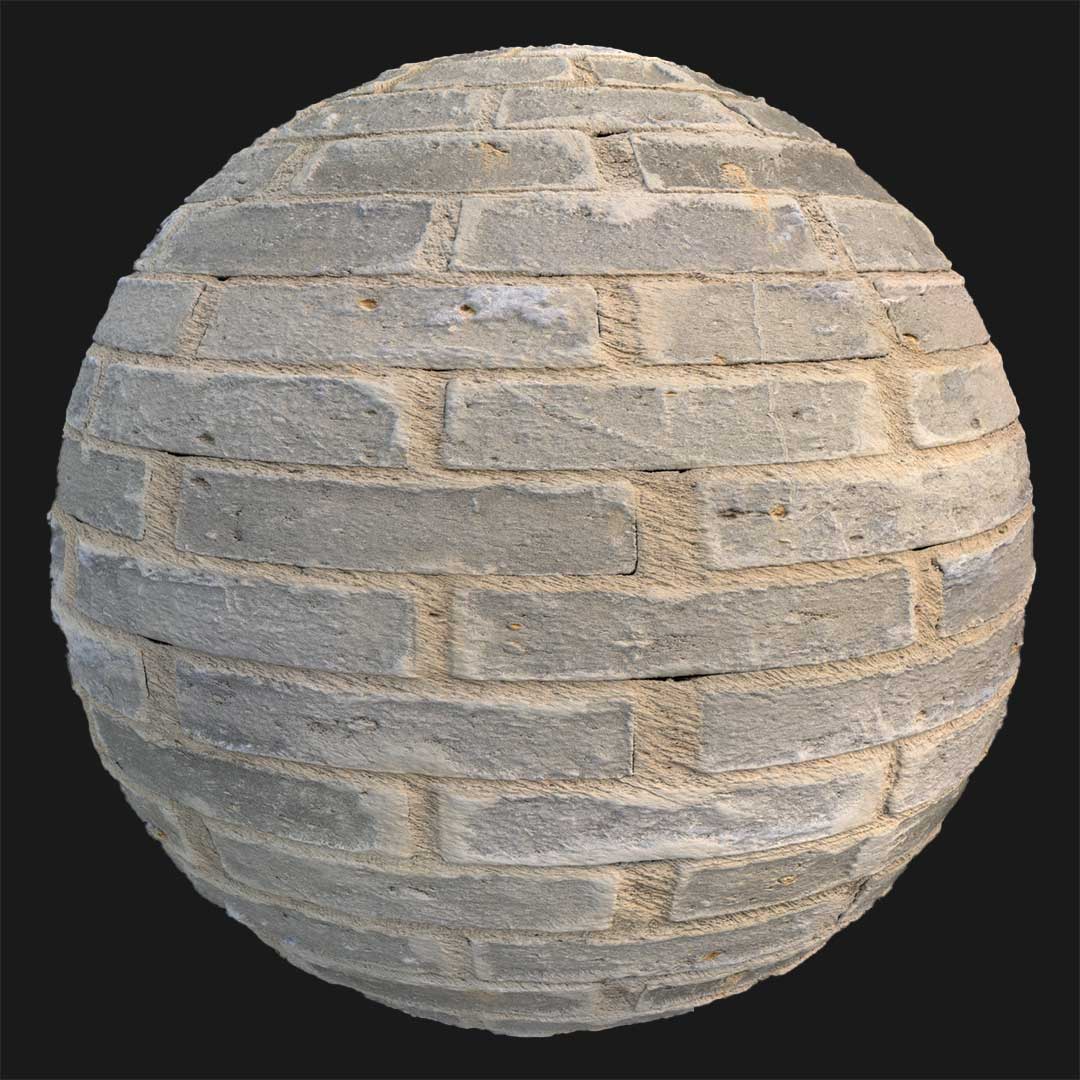

irregular brick wall material for games
This destroyed brick wall material Unreal Engine represents a type of construction often seen in low-budget rural structures, abandoned industrial buildings, and improvised masonry walls.

The surface is not a clean demolition. Instead, it reflects a wall that was poorly executed from the beginning—built with leftover bricks, irregular fragments, and heavy cement patches filling the gaps.
Approximately half of the surface reads as raw cement, while the remaining areas expose broken brick pieces in faded red, yellow, grey, and muted blue tones. The result is visually chaotic but structurally believable. It carries a strong narrative: cost-cutting construction, material shortage, or emergency repair work. In real-time environments, this kind of surface immediately communicates neglect, economic hardship, or post-conflict context without additional storytelling elements.
Typical Problems This Material Solves
When building war zones, abandoned warehouses, or rural storage areas in Unreal Engine, artists often struggle with surfaces that look “designed” rather than accidental. Many damaged brick textures feel staged, with predictable crack patterns and artificial grunge overlays.
This material solves that by focusing on construction logic rather than surface damage. The irregular brick placement and uneven cement integration create a believable structural randomness. It avoids the repetitive crack patterns that typically break immersion in large modular environments.
Another common issue in game environments is tiling visibility across large walls. Because this material is seamless and built at 8K resolution, repetition is significantly minimized, even when applied to long perimeter walls or large industrial interiors.
Practical Use Cases
The primary application is in Unreal Engine environments that require narrative realism. It works particularly well for:
-
War-affected urban districts
-
Abandoned rural warehouses
-
Improvised village constructions
-
Post-industrial backdrops
-
Low-income residential areas
-
Military or survival game levels
In architectural visualization, it can also be used for conceptual storytelling scenes where socio-economic contrast is part of the narrative. For film previs or virtual production, the material helps create authentic secondary structures without excessive shader customization.
Rendering & Realism Notes
The PBR workflow ensures accurate light interaction across rough cement and fractured brick pieces. The surface roughness variation prevents flat specular behavior, especially under directional sunlight in Unreal Engine.
Because the wall includes both cement-heavy zones and exposed brick fragments, it reacts differently to grazing light, enhancing depth perception. The 8096×8096 resolution allows close camera movement in first-person environments without visible texture breakdown.
Normal and height information add structural credibility without exaggeration, maintaining performance balance for real-time applications.
Render Engine Compatibility
The material is optimized for Unreal Engine workflows, integrating directly into standard PBR material setups. It performs reliably under Lumen, baked lighting, and dynamic shadow systems.
For offline rendering in V-Ray and Corona Renderer, the maps translate cleanly into physical materials with predictable roughness and color response. However, its strongest advantage remains in Unreal Engine, where the structural irregularity reads convincingly in real-time environments.
Workflow Advantage with AfterBox
All materials are accessible through the lightweight AfterBox application (approximately 16MB). Users can browse and manage materials locally, then drag & drop the ready-made Unreal Engine material directly into their project.

For V-Ray and Corona inside 3ds Max, materials can also be imported directly without rebuilding shaders from scratch. This reduces setup time and ensures consistency across real-time and offline workflows.
Soft CTA
Access a comprehensive library of brick materials with an AfterBox subscription.

Save time on material setup
Instead of downloading this texture, use the optimized ready-made material for VRay , Corona Renderer (3ds Max) and Unreal Engine available in AfterBox.
No manual setup


