
 Build Faster with AfterBox
Access over 4000 ready-to-use materials for Unreal Engine, V-Ray and Corona.
Create your account and receive $12 free credit.
Lighting design relies on balance, shadow, and intention. Among the core layers of illumination, accent lighting serves as the visual highlight of a space. It directs attention, adds depth, and creates dramatic interest in both interior and exterior environments. Whether highlighting a fine painting, textured stonework, or an architectural facade, accent lighting turns plain surfaces into striking features.
This comprehensive guide explains what accent lighting is, how it functions within a layered lighting scheme, and the technical guidelines required to execute it like a professional designer.
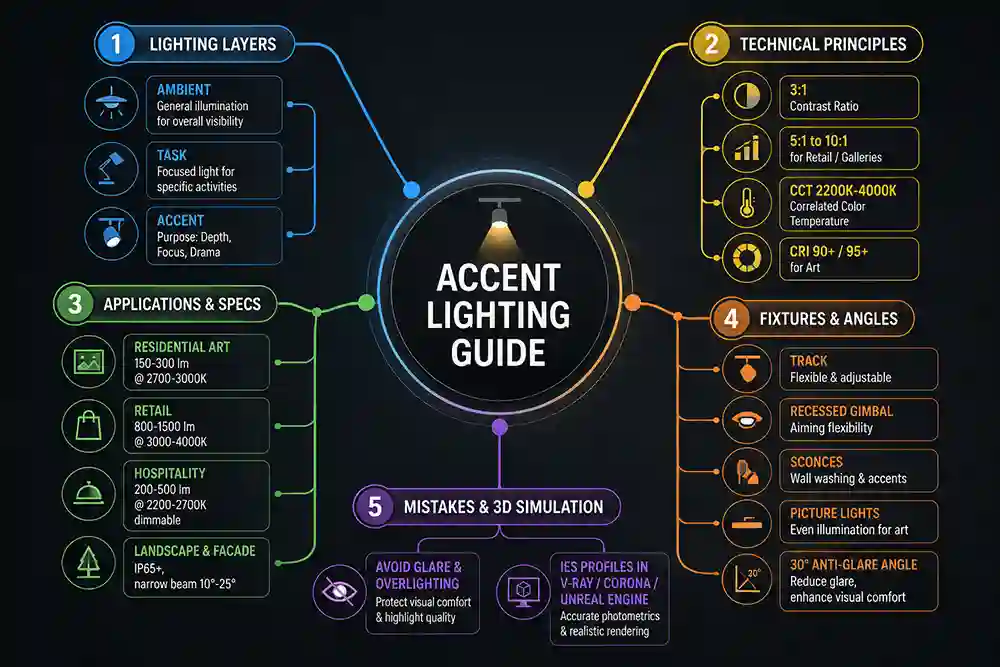
Understanding Accent Lighting: Definition and Core Purpose
Accent lighting is a concentrated form of illumination intended to highlight a specific object, texture, or architectural element. Unlike general lights that simply make a space visible, this feature draws the eye to deliberate visual anchor points.
Professional lighting design typically relies on three main layers:
- Ambient Lighting: Provides general ambient illumination for overall visibility and movement.
- Task Lighting: Delivers bright, targeted light for specific activities like reading, cooking, or working.
- Accent Lighting: Delivers controlled directional lighting to add drama, dimension, and emphasis to curated features.
By integrating focal lighting alongside task and ambient sources, a space avoids flat, monotonous light. Accent fixtures transform a room from purely functional to visually compelling.
Looking for a Faster Workflow?
Instead of creating every material manually, use a library of over 4000 ready-to-use materials and import them into your projects in seconds.
The 3:1 Rule and Technical Design Principles
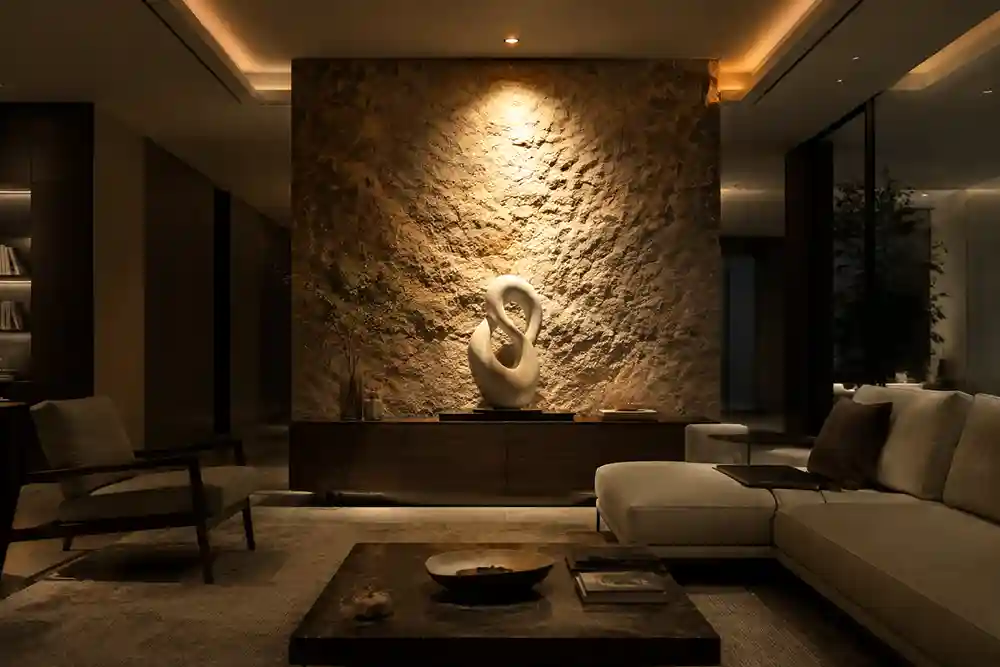
To make a feature stand out, directional lighting must be noticeably brighter than the surrounding background. The foundational standard in lighting design is the 3:1 contrast ratio rule. The light hitting your intended focal point should be roughly three times brighter than the general ambient light level around it.
In high-contrast or dramatic spaces, such as art galleries or luxury retail stores, designers may use contrast ratios as high as 5:1 or even 10:1. However, in comfortable residential settings, a 3:1 ratio provides clear emphasis without causing uncomfortable glare.
Color Temperature and CRI Considerations
Lumens alone do not guarantee good lighting quality. Color rendering and color temperature are equally critical:
- Color Temperature (CCT): Measured in Kelvin (K). Warm tones (2200K–3000K) work best for residential spaces, artwork, and hospitality. Neutral or cool tones (3500K–4000K) suit modern architecture, retail, and commercial facades.
- Color Rendering Index (CRI): Measures how accurately a light source reveals true colors compared to natural daylight. Always select fixtures with a CRI of 90 or higher for art, materials, and exterior surfaces. CRI 95+ is preferred for galleries and museum display.
Lumen and CCT Guidelines by Application
Different spaces require distinct light outputs and color temperatures. Below are concrete technical targets for various design applications.
Residential Artwork and Features
Artwork requires targeted light without excessive heat or UV radiation that causes material degradation. Modern LED fixtures are ideal.
- Recommended Lumens: 150 to 300 lumens per spot.
- Recommended CCT: 2700K to 3000K (Warm White).
- Key Requirement: Minimum 90 CRI (95+ preferred) with zero UV emission.
Retail Displays and Merchandising
Retail stores use elevated focal lighting to make products visually appealing and increase buyer engagement.
- Recommended Lumens: 800 to 1,500 lumens per light head.
- Recommended CCT: 3000K to 4000K (Neutral White).
- Key Requirement: High contrast ratios (5:1 to 8:1) relative to store aisles.

Hospitality and Dining Environments
Restaurants, hotels, and lounges use intimate focal lighting to highlight tables, textured walls, and bar displays.
- Recommended Lumens: 200 to 500 lumens per fixture.
- Recommended CCT: 2200K to 2700K (Very Warm White).
- Key Requirement: Fully dimmable fixtures to adapt to daytime and evening transitions.
Outdoor Landscaping
Landscape accenting brings trees, garden sculptures, and water features to life after sunset.
- Recommended Lumens: 100 to 400 lumens per spotlight.
- Recommended CCT: 2700K to 3000K (Warm Natural Tones).
- Key Requirement: Weather-proof construction with IP65 or higher wet-location ratings.
Exterior Building Facades
Architectural facade lighting emphasizes structural columns, stone textures, archways, and rooflines on commercial and residential structures.
- Recommended Lumens: 1,000 to 4,000+ lumens per fixture depending on building height.
- Recommended CCT: 3000K to 4000K (or static/dynamic RGBW systems).
- Key Requirement: Narrow beam angles (10° to 25°) for vertical column grazing.
Comparing Accent Lighting Fixture Types
Choosing the correct fixture hardware ensures proper beam control and seamless architectural integration. The table below outlines common directional lighting options. (IES)
| Fixture Type | Primary Use Case | Typical Beam Angle | Mounting Style |
|---|---|---|---|
| Track Lighting | Art galleries, retail displays, adjustable residential walls | 15° – 40° adjustable | Surface track or recessed track |
| Wall Sconces | Corridors, feature walls, bedside backdrop highlights | 60° – 120° wide flood | Surface wall-mounted |
| Recessed Spotlights | Targeted floor items, wall washing, localized accenting | 10° – 35° narrow spot | Ceiling recessed (gimbal or fixed) |
| Picture Lights | Mounted directly above oil paintings, framed prints, photos | 120° asymmetric flood | Wall or frame attached |
| Uplights & Downlights | Architectural columns, trees, facade grazing, soffits | 10° – 25° tight beam | In-ground, surface stake, or ceiling mount |
Application Guide: Rooms and Building Types
Implementing targeted accent lighting requires tailoring fixture choices to specific environments.
Living Rooms and Media Spaces
In living areas, use adjustable recessed gimbals to cast light across fireplace stonework or built-in shelving. Position lights at a 30-degree angle from vertical walls to prevent harsh shadows and avoid direct glare for seated occupants.
Bedrooms and Personal Retreats
Use warm wall sconces or low-wattage LED strip channel hidden inside headboards or cove ceilings. Keep light subtle (2700K) to promote relaxation while highlighting decorative headboards or textured plaster walls.
Kitchens and Dining Areas
Highlight glass-front cabinetry using internal puck lights. In dining spaces, use narrow beam spotlights focused directly on centerpieces or artwork, ensuring light does not spill into guests’ eyes.
Retail and Commercial Spaces
Deploy adjustable track systems using high-CRI LED modules. Direct tight beam spotlights toward featured product displays. Ensure ambient light stays lower so high-contrast focal lighting guides customer walk-paths.
Exterior Architectural Facades
Building facades require specialized narrow-beam floodlights or linear wall grazers. Mount in-ground fixtures close to textured walls to graze brickwork or stone. Use narrow beam spotlights at column bases to create sweeping vertical lines of light across tall structures.
Common Accent Lighting Mistakes to Avoid
Achieving effective focal lighting requires careful planning. Avoid these common installation errors:
- Direct and Indirect Glare: Pointing spotlights at reflective surfaces like glass frames or polished tile creates blinding hot spots. Angle fixtures 30 degrees relative to walls to minimize direct line-of-sight glare.
- Incorrect Beam Angle Selection: Using a wide beam floodlight on a small artwork spreads light onto surrounding walls, ruining visual contrast. Match beam spreads tightly to the target object dimensions.
- Poor Color Rendering: Installing low-CRI light sources causes artwork, fabrics, and natural materials to look washed out or gray. Always verify a CRI rating above 90.
- Overlighting and Visual Clutter: Attempting to highlight every wall or decorative item eliminates dynamic shadow, creating visual confusion. Choose key focal points selectively.
Simulating Accent Lighting: Rendering in V-Ray, Corona, and Unreal Engine
Modern architects and lighting designers rarely guess beam angles or lumen levels on site. Instead, they pre-visualize installations using advanced 3D rendering engines like Chaos V-Ray, Chaos Corona, and Unreal Engine.
These software engines use real-world Photometric IES (Illuminating Engineering Society) files provided by lighting manufacturers. Designers import these digital profiles directly into 3D models to evaluate:
- Exact light distribution and beam cut-offs.
- Accurate 3:1 contrast ratios between ambient and directional lighting layers.
- Surface texture grazing effects under realistic color temperatures.
- Inter-reflections and real-time shadows before drilling holes or laying cables.
By simulating scenes digitally, teams refine light positioning, output lumens, and color temperatures ahead of physical construction. This precise workflow guarantees professional results on site.
