


Subtle striated light plaster surfaces are typically found in contemporary European interiors where visual calm and material precision are more important than decorative expression. This type of architectural plaster appears in gallery walls, refined residential living areas, quiet office lobbies, and Japandi-inspired spaces that rely on controlled light and neutral tones rather than contrast or ornament.

The very light off-white grey color works as a balancing background that adapts to both warm and cool lighting schemes. Because the horizontal striations remain extremely soft and regular, the surface introduces rhythm without visual noise. The result is a wall finish that feels intentional, architectural, and quietly premium rather than expressive or rustic.
Typical Problems This Material Solves
In many interior visualization projects, designers struggle with walls that are either too flat to feel realistic or too textured to remain calm in minimal compositions. Perfectly smooth shaders often look artificial in close-up renders, while aggressive plaster or concrete textures can distract from furniture, lighting, or artwork.
This subtle striated plaster resolves that tension. The micro-variation created by controlled horizontal lines adds scale reference and realism, yet the texture remains visually silent. It allows the architecture, not the surface detail, to stay dominant. This makes it particularly useful in projects where restraint, clarity, and spatial balance are core design goals.
Practical Use Cases
In residential interiors, this material is frequently used for background living-room walls, corridors, and bedrooms where designers want softness without emptiness. In commercial environments, it appears in reception areas, boutique galleries, and premium office spaces where neutrality must still communicate quality.
For real-time environments and game spaces, the texture functions well in calm architectural scenes, exhibition halls, and narrative interiors that depend on believable but non-distracting surfaces. Because it is seamless and non-directional beyond the gentle horizontal rhythm, it scales efficiently across large wall sections without visible repetition.
Rendering & Realism Notes
From a rendering perspective, subtle plaster finishes are demanding because realism depends on extremely fine surface response rather than bold displacement. The controlled matte reflection, delicate normal variation, and clean tonal range allow light to glide softly across the wall, producing believable gradients in both daylight and artificial illumination.
This makes the material particularly effective for close-up architectural shots, where overly flat shaders would immediately break realism. The 4K resolution and PBR consistency ensure stable results across different camera distances and lighting intensities.
Render Engine Compatibility
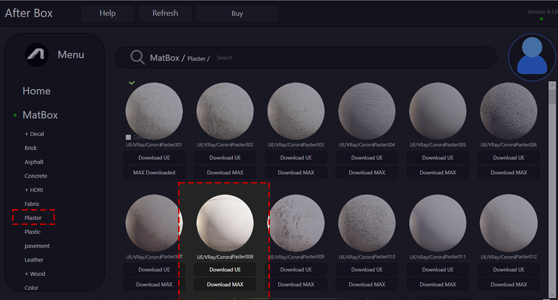
The material is prepared for efficient use in Unreal Engine, V-Ray, Corona Renderer, and Blender, supporting physically accurate shading without complex manual setup. In real-time engines like Unreal, the lightweight yet detailed surface maintains performance while preserving believable light interaction. In V-Ray and Corona, the calibrated roughness and normal response translate into predictable, production-ready renders suitable for high-resolution stills and animations.
Workflow Advantage with AfterBox
All materials are accessible through the lightweight AfterBox application (approximately 16 MB), where users can drag and drop ready-configured materials directly into Unreal Engine or into V-Ray and Corona within 3ds Max. This approach removes repetitive shader construction and keeps visual consistency across projects while remaining purely workflow-oriented rather than feature-driven.


Save time on material setup
Instead of downloading this texture, use the optimized ready-made material for VRay , Corona Renderer (3ds Max) and Unreal Engine available in AfterBox.
No manual setup


