


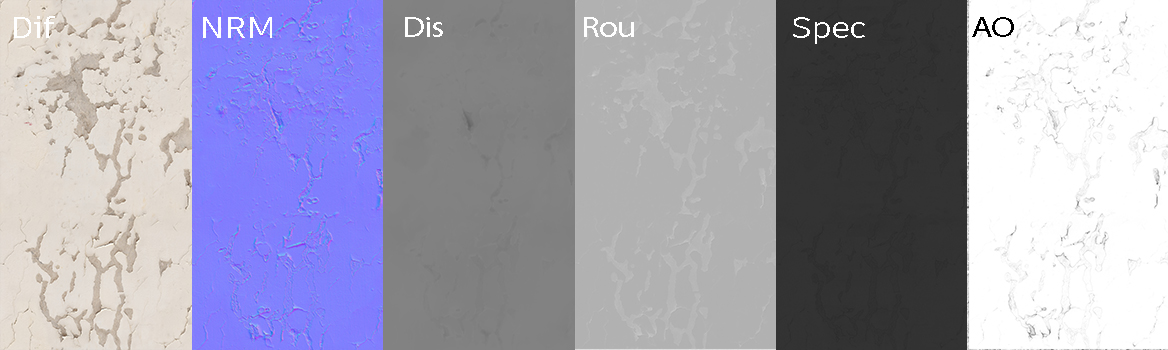
Layered ridged white plaster textures bring a sense of history and tactility to modern architectural projects. This material is often applied in industrial lofts, renovated historical interiors, and rustic cafés, where the walls need to convey depth, age, and craftsmanship. The subtle off-white and cream tones combined with exposed underlayers of beige and light grey create natural shading, making spaces feel authentic without overpowering the surrounding elements.
The distressed, two-layer surface with pronounced ridged edges adds visual rhythm and character to otherwise minimal or flat walls. It provides an aged, industrial aesthetic while maintaining a neutral palette that complements both warm and cool lighting scenarios.
Typical Problems This Material Solves
Many interior and architectural projects struggle with walls that look too flat or overly uniform in 3D renders. Standard plaster or concrete shaders can appear sterile or artificial, especially in close-ups. Similarly, highly detailed textures often create visual noise and distract from the composition of furniture, lighting, or décor.
The layered ridged plaster texture addresses these challenges by introducing subtle depth, flaking details, and tactile irregularities without overwhelming the scene. It allows visual interest and realism while keeping attention on the spatial layout and architectural intent.
Practical Use Cases
In real projects, this plaster texture has been applied to:
-
Interior lofts and industrial-style apartments, enhancing accent walls and feature areas.
-
Historical renovations, where peeled and layered textures reflect genuine wear and construction detail.
-
Cafés, restaurants, and boutique hotels, creating tactile, immersive environments with a handcrafted feel.
-
Game environments, particularly abandoned or aged buildings, where realistic wall degradation enhances storytelling.
-
Architectural renders, serving as visually engaging backgrounds for modern and rustic spaces.
Its organic, non-repetitive flaking pattern ensures that each wall appears unique and convincing in both still images and animations.
Rendering & Realism Notes
The matte, distressed finish is ideal for realistic rendering, as it avoids reflective artifacts while allowing natural light to accentuate depth. Ridged edges create subtle shadows that add dimensionality to flat walls, enhancing close-up views. Combined with the 4K resolution and PBR maps (Base Color, Normal, Specular, Displace, Roughness), this material delivers production-ready realism suitable for high-detail architectural visualization.
The natural color transitions between the top layer and the exposed underlayer mimic the light scattering found in real plaster, ensuring that renders maintain a convincing aged look under various lighting conditions.
Render Engine Compatibility
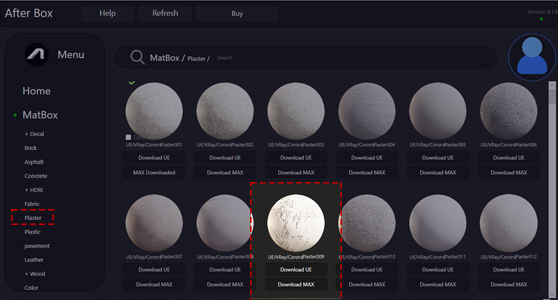
This material is optimized for Unreal Engine, V-Ray, and Corona Renderer. In Unreal Engine, the texture can be applied directly to walls or architectural models, preserving fine ridged details and depth cues even in real-time scenes. For offline renderers like V-Ray and Corona, the PBR maps allow accurate light interaction and realistic shadowing without extensive manual shader setup, ensuring both speed and fidelity in production workflows.
Workflow Advantage with AfterBox
All materials, including this layered ridged plaster, are accessible through the lightweight AfterBox application (~16MB). Users can drag and drop the material directly into Unreal Engine, V-Ray, or Corona in 3ds Max, streamlining the workflow and avoiding repetitive manual shader creation. AfterBox also supports quick adjustments such as scaling, color correction, and tiling while maintaining consistent quality across multiple projects.

Save time on material setup
Instead of downloading this texture, use the optimized ready-made material for VRay , Corona Renderer (3ds Max) and Unreal Engine available in AfterBox.
No manual setup


