


Free stucco material for Unreal Engine is widely used to visualize contemporary exterior façades with rough mineral finishes.
This coarse light grey roughcast surface appears frequently in European housing blocks, civic buildings, and restrained renovation projects.
In these contexts, designers usually prioritize durability, neutrality, and tactile depth instead of decorative coatings.
Because the surface is fully matte, it reads as a calm architectural background in both daylight and overcast conditions.
In addition, subtle tonal variation created by mixed mineral grains prevents the façade from looking flat at mid or close distance.
The dense, uniform grain distribution also reinforces a sense of structural solidity and permanence.
As a result, the material communicates strength, honesty, and minimalism without relying on gloss, color contrast, or ornamental detail.
This visual identity makes it especially suitable for brutalist, modernist, and infrastructure-driven architectural scenes rendered in real time.
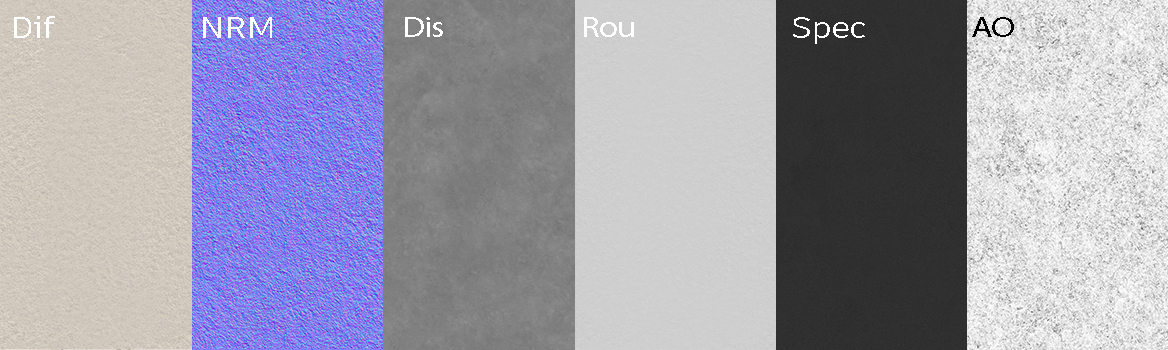
rough exterior plaster texture
Problems Solved by Rough Plaster Textures in Unreal Engine
Exterior visualization workflows frequently struggle with plaster or concrete finishes that look too smooth, repetitive, or artificially clean when rendered in real-time engines. Standard grey wall shaders often lack the micro-shadow depth required to convey scale, causing façades to feel miniature or synthetic.
This rough stucco material addresses those issues through pronounced displacement information and non-directional granular distribution. The extra-rough surface breaks light consistently across wide elevations, preventing visible tiling in long façade shots. At the same time, the neutral grey tone avoids unwanted color casting in global illumination, which is particularly important in Unreal Engine daylight scenes and physically based rendering pipelines.
Practical Use Cases for Exterior Stucco in Real-Time Scenes
In architectural visualization, this material is well suited for residential blocks, parking structures, public infrastructure, and renovation studies where cost-efficient plaster façades are part of the design narrative. It also integrates naturally into brutalist or post-industrial compositions that rely on texture rather than ornamentation.
For interior scenes, the same roughcast surface can be applied to stairwells, basement corridors, gallery back-of-house zones, or service spaces where untreated mineral finishes are expected. In game environments, it supports realistic urban districts, institutional buildings, or background structures that require believable scale without excessive shader complexity.
Because the texture is seamless and non-directional, it performs reliably on large modular meshes and landscape-adjacent retaining walls—situations where visible repetition would otherwise break immersion.
Rendering Realism of a Light Grey Stucco PBR Material
Realistic perception of this stucco depends heavily on displacement or height mapping rather than normal detail alone. The granular protrusions create micro-occlusion that interacts strongly with grazing light, especially during sunrise or sunset lighting setups in Unreal Engine.
Its fully diffuse reflectance ensures predictable exposure control in HDR lighting environments and prevents specular hotspots that would contradict mineral plaster behavior. When rendered at 4K resolution, the grain structure maintains clarity in close-up façade studies, supporting cinematic camera movement and walkthrough sequences without texture breakdown.
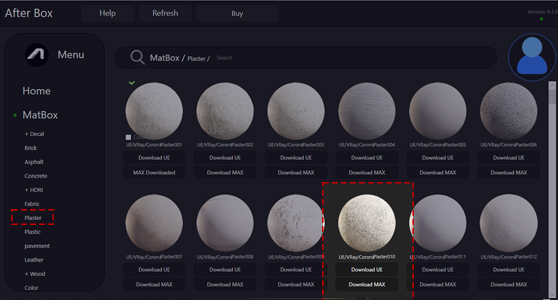
Render Engine Compatibility in Unreal Engine, V-Ray, and Corona
This light grey rough stucco material is optimized for physically based workflows across Unreal Engine, V-Ray, and Corona Renderer. In Unreal Engine, displacement-driven surface depth and calibrated roughness values allow the façade to react naturally to dynamic daylight and lumen-based global illumination. Within V-Ray and Corona for 3ds Max, the same PBR structure translates into stable shading, accurate shadow softness, and predictable material scaling for architectural stills or animations.
Workflow Advantage with AfterBox for Stucco Materials
All related plaster and stucco materials are accessible through the lightweight AfterBox application (approximately 16 MB), where assets can be browsed and transferred directly into Unreal Engine, V-Ray, or Corona scenes using a drag-and-drop workflow inside 3ds Max. This approach reduces manual shader setup and keeps material libraries organized across projects. Subscription structure and access details are available on the official pricing page:
https://after-box.com/pricing/
Access a comprehensive library of plaster and stucco materials with an AfterBox subscription.


Save time on material setup
Instead of downloading this texture, use the optimized ready-made material for VRay , Corona Renderer (3ds Max) and Unreal Engine available in AfterBox.
No manual setup


